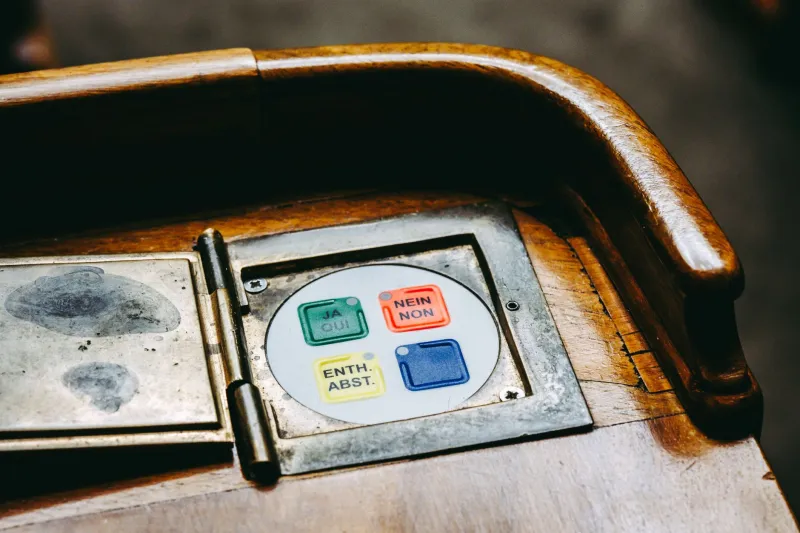
Equal Airtime, Unequal Evidence: How the Pursuit of Balance Distorts British Public Debate

The Principle That Became a Problem
Impartiality is among the most cherished values in British journalism. From the BBC's statutory obligations under its Royal Charter to the editorial codes governing broadsheet newspapers, the expectation that reporters present multiple perspectives has long been treated as a guarantor of democratic health. The instinct is understandable: a press that suppresses inconvenient viewpoints is a press that cannot be trusted.
Yet there is a category error embedded in the most common application of this principle. When a journalist places a climate scientist alongside a sceptic with no peer-reviewed publication record, or invites a vaccine-hesitant campaigner to 'balance' the view of an epidemiologist, the formal structure of balance is preserved whilst the epistemic content is quietly corrupted. The audience receives a signal that two positions are roughly equivalent in evidential weight when, in demonstrable fact, they are not. This phenomenon has a name in academic literature: false equivalence. Its consequences for public understanding are neither trivial nor hypothetical.
Case Study One: Climate Scepticism in the British Press
For much of the 2000s and into the 2010s, British broadsheets — including titles that would describe themselves as broadly progressive — routinely offered column inches to voices disputing the scientific consensus on anthropogenic climate change. A 2011 analysis by the Reuters Institute for the Study of Journalism found that UK newspapers published a significantly higher proportion of climate-sceptical opinion than their counterparts in most comparable democracies. The motivation was rarely ideological in isolation; editors framed it as a commitment to open debate.
The measurable effect, however, was to sustain public uncertainty about a matter on which the scientific community had reached overwhelming agreement. Polling conducted by Ipsos in subsequent years consistently showed that a substantial minority of British adults believed the evidence on climate change remained genuinely contested among experts — a belief that the journalistic record had actively cultivated rather than corrected. This is not a peripheral concern for debate educators: when foundational empirical claims are treated as open questions, the quality of policy argument built upon them degrades accordingly.
Case Study Two: Vaccine Hesitancy and the MMR Controversy
Perhaps no episode better illustrates the consequences of false equivalence in British media than the coverage of Andrew Wakefield's 1998 Lancet paper purporting to link the MMR vaccine to autism. The paper was eventually retracted, and Wakefield was struck off the medical register. Yet for nearly a decade, broadcast and print journalists frequently framed the debate as a genuine scientific dispute between two legitimate camps, inviting parents to 'weigh up both sides'.
The British Medical Journal's subsequent investigation, published in 2011, described the original study as fraudulent. Yet the framing of equivalence had already done measurable damage: MMR uptake in England fell from 92 per cent in 1995 to 80 per cent by 2003, well below the threshold required for herd immunity. Measles outbreaks followed. The case is now studied in journalism schools precisely because it demonstrates that the application of balance to asymmetric evidence does not serve the public interest — it undermines it.
Why Journalists Persist With the Convention
Understanding why false equivalence persists requires engaging seriously with the structural pressures that produce it. Several factors are relevant.
First, impartiality regulation creates genuine legal and institutional incentives. Ofcom's Broadcasting Code places enforceable obligations on licensed broadcasters to reflect a range of perspectives on controversial subjects. Editors operating under such frameworks are understandably cautious about appearing to exclude any viewpoint, even one that lacks evidential foundation.
Second, the commercial logic of controversy is difficult to resist. Dissenting voices generate engagement; consensus is, by definition, less dramatic. A broadsheet that publishes only the mainstream scientific view on a given topic may be epistemically responsible but commercially unremarkable.
Third, and perhaps most importantly, many journalists lack the scientific training to distinguish between a genuine empirical dispute and a manufactured one. The difference between legitimate uncertainty — which exists in abundance across the sciences — and the strategic amplification of doubt by interested parties is not always immediately apparent to a generalist reporter working to a deadline.
Alternative Frameworks: What Responsible Reporting Looks Like
The argument here is not that dissenting views should be suppressed. On genuinely contested policy questions — how aggressively to price carbon, whether vaccine mandates are proportionate, which net-zero technologies merit public investment — robust adversarial debate is precisely what democratic deliberation requires. The distinction that matters is between empirical questions, where evidence can in principle adjudicate between positions, and normative questions, where values legitimately diverge.
Several alternative editorial frameworks have been proposed and, in some cases, adopted.
Weight-of-evidence reporting requires journalists to represent not merely the existence of competing claims but the relative proportions of expert opinion supporting each. If 97 per cent of climate scientists endorse a given conclusion, that asymmetry should be visible in the coverage, not obscured by a one-to-one interview structure.
Source credentialling involves making explicit to audiences the nature and extent of a commentator's expertise. Identifying a speaker not merely as 'a scientist' but as 'a researcher with no publications in this field funded by an industry body with commercial interests in the outcome' equips readers with the contextual information they need to assess claims independently.
The 'false balance' label, adopted by some science journalists in recent years, involves explicitly flagging when a minority position lacks evidential support rather than allowing the architecture of debate to imply parity that does not exist.
The BBC has made partial moves in this direction: its 2018 internal review acknowledged that the corporation had, in some instances, misrepresented scientific consensus by over-platforming sceptical voices, and issued guidance to staff accordingly. Whether such guidance has been consistently implemented remains a matter of ongoing scrutiny.
The Implications for Debate Education
For students and educators engaging with media literacy, the false equivalence problem offers a productive case study in the difference between the form and the substance of argument. A debate that is structurally symmetrical — two speakers, equal time, neutral chair — is not necessarily an epistemically sound one. The quality of an argument is determined by its evidence and reasoning, not by the procedural fairness of the platform on which it is presented.
This distinction is foundational to rigorous critical thinking. Teaching students to ask not merely 'has the other side been heard?' but 'what is the evidential basis for each position, and are those bases genuinely comparable?' produces a more sophisticated analytical disposition than the reflex assumption that balance is always a virtue.
The burden of balance, properly understood, is not the obligation to give every claim equal standing. It is the harder obligation to represent the actual state of knowledge with accuracy and intellectual honesty — even when that representation is asymmetric, and even when asymmetry is commercially inconvenient.