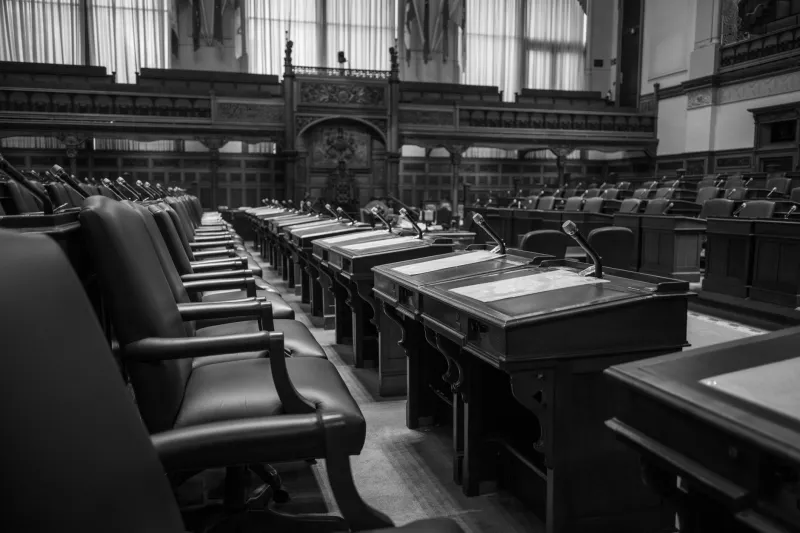
Untested and Unravelling: What Happens When British Institutions Stop Arguing With Themselves

Photo: Foreign, Commonwealth & Development Office, CC BY 2.0, via Wikimedia Commons
The Silence Before the Failure
There is a particular kind of institutional confidence that does not announce itself loudly. It does not swagger or boast. It simply stops asking questions. Meetings conclude without meaningful objection. Reports circulate and return endorsed. Dissenting voices, if they existed at all, learn through subtle professional signals that persistence is unwelcome. And then, sometimes years later, the policy collapses—and everyone involved insists they could not possibly have seen it coming.
Britain has a distinguished record of producing exactly this kind of failure. The common thread running through many of its most consequential institutional breakdowns is not incompetence in the conventional sense. The individuals involved were frequently well-qualified, diligent, and operating in good faith. What they lacked was a structured mechanism for testing their own assumptions before those assumptions became irreversible commitments.
For students of argumentation and public policy alike, this pattern deserves serious scrutiny. A sound argument is not merely one that appears coherent to those who constructed it. It is one that has survived genuine challenge.
When Agreement Becomes a Warning Sign
The Mid Staffordshire NHS Foundation Trust scandal, examined extensively in the Francis Report of 2013, offers one of the starkest illustrations of what happens when an organisation mistakes internal harmony for institutional health. The Trust had developed a culture in which concerns raised by nursing staff were systematically minimised, complaints were processed rather than investigated, and performance metrics were treated as proof of quality rather than proxies for it. Crucially, those within the organisation who might have disrupted this consensus faced professional consequences for doing so.
The result was not a sudden, dramatic collapse but a prolonged deterioration that external scrutiny eventually made impossible to ignore. Robert Francis QC's report identified a "culture of fear" and a failure of openness that had insulated poor practice from correction. What is particularly instructive from a debate and reasoning perspective is that the information required to identify the problem was, in many cases, already present within the organisation. It was the absence of a mechanism for surfacing and stress-testing that information—rather than the absence of the information itself—that proved fatal.
Similar dynamics have been documented in civil service contexts. The Iraq dossier of 2002, scrutinised by the Chilcot Inquiry, revealed how the apparatus of government can produce confident, polished conclusions from a process in which challenge was structurally limited. Lord Chilcot's report noted that the Joint Intelligence Committee's assessments were not subjected to the kind of rigorous sceptical examination that their consequences demanded. The machinery of consensus had functioned smoothly; the machinery of adversarial testing had not.
The Argument Against Arguing
It would be unfair to suggest that British institutions are simply indifferent to internal challenge. Many would contend that they actively invite it. Risk registers are maintained. Audit committees convene. Stakeholder consultations are published. The formal architecture of scrutiny is frequently impressive.
The difficulty is that formal architecture and genuine challenge are not the same thing. A risk register that lists only the risks the organisation has already decided to accept is not a tool of scrutiny; it is a record of conclusions. A stakeholder consultation that presents a fully formed proposal and invites comment within a narrow window does not replicate the conditions of a genuine adversarial test. The question worth posing in any educational or policy context is not whether challenge exists on paper, but whether it is structurally capable of changing outcomes.
There is also a cultural dimension that is distinctly British in character. The premium placed on collegiality, on not making meetings uncomfortable, on respecting the authority of those who have already reached a view—these are not trivial social norms. They reflect values that serve genuine purposes in many contexts. The problem arises when they migrate from the boardroom into the domain of policy reasoning, where the cost of unchallenged error is borne not by the organisation but by the public.
Frameworks That Force the Argument
Several practical methodologies exist for institutionalising adversarial reasoning before decisions become irreversible, and they deserve wider adoption in British public life.
Red teaming, borrowed from military and intelligence contexts, assigns a dedicated group the explicit task of defeating a proposed strategy. Unlike conventional peer review, red teaming does not merely invite criticism—it mandates it. Participants are evaluated not on whether they endorse the proposal but on the quality of the challenges they mount against it. The Cabinet Office has experimented with elements of this approach, but its application remains inconsistent and largely discretionary.
Pre-mortem analysis, developed in organisational psychology, asks decision-makers to imagine that a policy has already failed catastrophically and then work backwards to identify the most plausible causes. The technique is disarmingly simple and has been shown in research settings to improve the identification of genuine risks that forward-looking assessments overlook. It reframes pessimism as a professional obligation rather than a personal disposition.
Structured devil's advocacy formalises the role of the dissenter within a decision-making process, designating an individual or team to argue against the prevailing view regardless of their personal position. This approach, used in some legal and philosophical traditions, has the advantage of separating the act of challenge from the professional identity of the challenger—removing the personal cost of dissent without removing its analytical value.
Each of these frameworks rests on the same foundational insight: that the strength of an argument cannot be assessed by those who are committed to its success. Britain's institutions, if they are serious about avoiding the failures that have repeatedly damaged public trust, need to build in the conditions under which their best ideas can be properly broken.
What This Means for Education and Training
The implications extend well beyond policy circles. Students learning to construct arguments—whether in the context of formal debate, academic essay writing, or professional practice—are frequently taught to build the strongest possible case for a position. Fewer are taught to systematically attack their own case before presenting it.
This is a significant gap. The capacity to identify the weakest point in one's own argument, to anticipate the most damaging objection and either address it or revise the position accordingly, is not a supplementary skill. It is the difference between advocacy and reasoning. British universities and secondary schools that take debate seriously would do well to incorporate structured self-challenge into their curricula, not as a rhetorical flourish but as an epistemic discipline.
The Productive Discomfort of Genuine Challenge
Unchallenged consensus is not a sign of institutional strength. In most cases, it is a sign that the conditions for honest challenge have not been created. Britain's most consequential policy failures have rarely been the product of malice or stupidity. They have been the product of organisations that were very good at agreeing with themselves.
The antidote is not perpetual conflict or the valorisation of contrarianism for its own sake. It is the deliberate, structured creation of conditions in which good arguments are made better by surviving serious opposition—and weak arguments are identified before they become policy. That is not a radical proposition. It is, in fact, the oldest purpose of reasoned debate.